
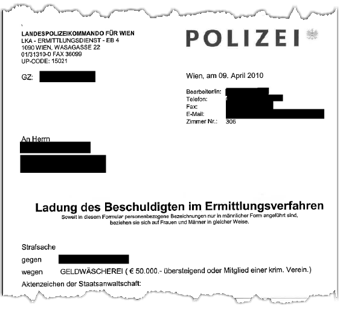
- What does it mean to be a suspect in a criminal case?
Being a suspect means that you are under investigation for a specific criminal offense. An accusation does not constitute a conviction; the presumption of innocence applies until a final decision is reached.
- What Rights Do Suspects Have Under Section 49 of the Austrian Code of Criminal Procedure (StPO)?
In particular, Section 49 of the Austrian Code of Criminal Procedure (StPO) lists the right to information about the suspected offense and the essential procedural rights, the right to a defense, the right to inspect the case file, the right to submit motions for evidence, the right to participate in certain procedural acts, the right to appeal and seek legal remedies, the right to translation assistance, and the right to request a separation of proceedings.
- Do I have to make a statement if I am summoned by the police?
No. Suspects have the right to remain silent and are not required to comment on the allegations against them. A statement may help the defense, but it can also be used as evidence against the suspect. It is therefore advisable to consult a criminal defense lawyer before making a statement.
- Can I consult a defense lawyer before being questioned as a suspect?
Yes. You may choose a defense lawyer at any time, consult them before the questioning, and have them present during the questioning. It is therefore advisable to contact a criminal defense lawyer as soon as you receive the summons. After the questioning, or after each related part of it, the defense lawyer may ask additional questions and make statements.
- How does access to the case file help me during the preliminary investigation?
Access to the case file under Sections 51ff of the Austrian Code of Criminal Procedure (StPO) shows which investigative findings, statements and evidence the authorities have. It is an essential basis for an effective criminal defense. Before the preliminary investigation is concluded, access may be restricted if special circumstances give reason to fear that the purpose of the investigation could be jeopardized; a blanket or permanent refusal is not permitted.
- Can I submit my own motions for evidence?
Yes. Suspects may submit motions for evidence, for example requesting that defense witnesses be questioned or that other suitable evidence be taken.
- Can I attend further questioning sessions and the trial?
In particular, suspects have the right to attend an adversarial examination of witnesses and co-suspects, a reconstruction of the offense, and the trial. How to approach attending such hearings should be agreed with the defense lawyer.
- What legal remedies are available if my rights are violated?
If a violation of rights is alleged during the preliminary investigation, an objection for violation of rights under Section 106 of the Austrian Code of Criminal Procedure (StPO) may be considered. A complaint may be lodged against a court’s authorization of certain coercive measures, such as a house search. In addition, under the conditions of Section 108 StPO, an application may be filed to discontinue the preliminary investigation.
- Am I entitled to translation assistance?
Yes. If you do not sufficiently understand the language of the proceedings or cannot communicate sufficiently in it, you are entitled to translation assistance under Section 56 StPO. This is intended to ensure that you actually understand the allegations against you, your rights and the course of the proceedings.
- Can I request a separation of proceedings?
Yes. Since January 1, 2025, suspects have been able to request a separation of proceedings under Section 27 StPO. This may be particularly useful to avoid significant delays, to protect legitimate confidentiality interests, or to shorten detention. Whether an application is likely to succeed depends on the circumstances of the specific proceedings.
- What should I do after receiving a summons to appear for questioning as a suspect?
First, check which authority issued the summons, what offense you are alleged to have committed, and what date you are required to appear. Do not make any statement about the matter without first seeking legal advice if you cannot reliably assess the consequences of your statement.
Contact a criminal defense lawyer as early as possible. The defense lawyer can assess the allegations, request access to the case file, prepare for the questioning, and examine whether motions for evidence, an objection, a complaint or an application to discontinue the proceedings may be considered. In addition, the defense lawyer can work through the facts of the case with you and, where appropriate, prepare a statement in the form of a written submission. This means you do not necessarily have to face questioning by the police officers.
Do not ignore the summons; instead, clarify with your defense lawyer whether you need to appear in person and how to respond to the appointment. Deadlines and the contents of the summons can be decisive for your further criminal defense.
- Conclusion: Taking action early protects your defense
A summons to appear for questioning as a suspect should be taken seriously, but it is no reason to jump to conclusions about the outcome of the proceedings. Those who involve a defense lawyer early on can make targeted use of the right to remain silent, the right to inspect the case file, the right to submit motions for evidence and other rights of suspects.
Contact
Have you received a summons, or do you have questions about ongoing criminal proceedings? At KINDL.trusted, we stand by you with confidentiality and reliability. Arrange a no-obligation initial consultation.
Your contacts from our KINDL.Legal Defense practice area:

Marc Julian MAYERHÖFER
Partner | Rechtsanwalt

Sarah Höfler
Counsel | Rechtsanwältin
